
作者:乙公密石
来源:原创
时间:2026-08-26
阅读:442 次
哔哩哔哩
Air France-KLM tells GT their ban on portable air conditioners as baggage at Shanghai airport 'out of operation, safety reasons'_我的网站

一 | 巴黎8月12日电(记者崔可欣)国际能源署12日发布最新月度石油报告说,受霍尔木兹海峡持续封锁和燃料价格高企影响,全球石油消费继续受到抑制,预计2026年全球石油需求将日均减少160万桶,较上月报告预测的降幅扩大51万桶,2027年全球石油需求有望日均增加240万桶。
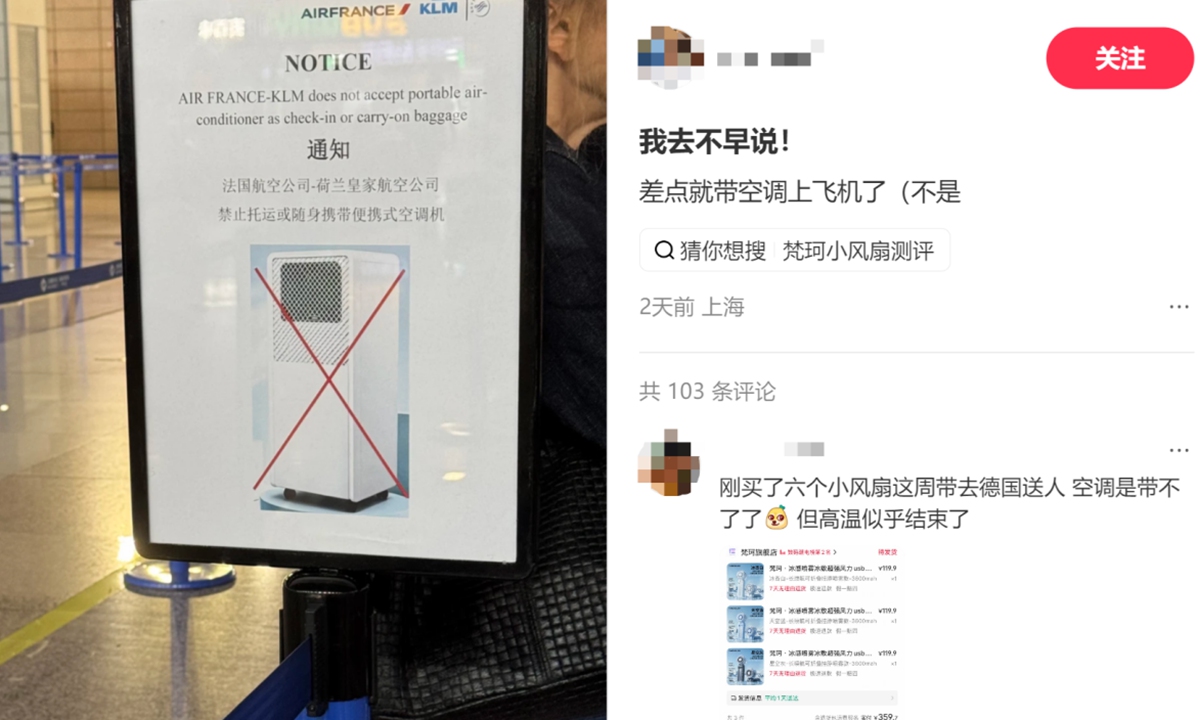
A Rednote post recently sparked discussion and jokes among netizens after showing a notice stating that "Air France-KLM does not accept portable air conditioners as checked or carry-on baggage," against the backdrop of extreme heatwaves in Europe this summer and the difficulty of securing one in European markets.
Air France-KLM customer service later confirmed to the Global Times on Monday that the restriction was in place, explaining that passengers' baggage must comply with relevant rules and requirements, which are established based on operational and safety considerations.
The discussion came as Europe has been hit by persistent extreme heat in recent months, triggered widespread heat alerts and a surge in local demand for air conditioners, a product that was not widely installed in European households.
After the RedNote post was released, some netizens shared similar experiences in the comments section, with one writing: "I just bought six small fans to take to Germany as gifts, [now that] Air conditioners are out of the question. But it seems the heatwave is finally over."
Some speculated that the sign was put up after travelers to Europe tried to imitate a widely reported case in which a Chinese employee based in Shanghai helped a French colleague visiting China on a business trip bring an air conditioner from China back to Europe by air in July.
The story was shared by the Chinese employee on RedNote. After researching different models, the Chinese selected a compact unit suitable for international transport based on its size and weight. The air conditioner reportedly used non-flammable R410A refrigerant, with a refrigerant charge of 350 grams, and contained no lithium battery. According to the post, the netizen concluded that the unit could be transported as regular baggage transport rather than being treated as dangerous goods.
The netizen also carefully consulted the ICAO technical instructions and IATA dangerous goods regulations to determine whether the air conditioner needed to be handled as dangerous goods, per the post.
The French colleague, with sufficient baggage allowance, only paid for additional packing services. The total cost came to 1,412 yuan ($209.26), including 1,260 yuan for the air conditioner, 130 yuan for airport packaging, and 22 yuan for a high-power European power adapter.
The French passenger was reportedly transported the air conditioner successfully and arrived in Barcelona.
However, airlines have reminded passengers that while some air conditioners may qualify for checked baggage, strict requirements still apply.
Battery and refrigerant restrictions must be followed, as portable air conditioners containing lithium batteries are strictly prohibited from being checked in. Meanwhile, size and weight limits must be considered as the equipment must comply with airline baggage allowances, which typically limit individual pieces to 23 kilograms or 32 kilograms, and total dimensions generally not exceeding 158 centimeters.
Professional packaging is also recommended, with travelers advised to use airport packing services to reduce the risk of damage during baggage handling.
Experts said that as Europe continues adapting to increasingly frequent heatwaves, the unusual trend of travelers carrying cooling equipment across borders highlights growing concerns over climate extremes, while also serving as a reminder that aviation safety rules remain a key consideration for transporting household appliances.
In second quarter of 2026, China-Europe freight trains have transported more than 100,000 portable air conditioners and key components, with a total cargo value of about $52 million, helping to ease supply pressures in the European market, according to a report by China Railway Group media.
。 报告指出,7月海湾地区石油供应复苏势头随中东形势逆转,基准原油价格一度升至两个月高点。受冲突重燃及外交局势骤变影响,油价在约40美元的宽幅区间内剧烈震荡。 供应方面,7月全球石油供应量日均增加240万桶,达到1.015亿桶,但仍较去年同期低630万桶。报告预计,2026年全球石油供应量将日均减少430万桶,2027年则有望反弹,日均增加830万桶,达到1.103亿桶。 库存方面,报告说,7月全球可观测石油库存减少6900万桶,主要原因是海湾和里海地区石油出口再次中断,海上运输中石油数量大幅下降。

二 | 报告预计,2026年第三季度全球石油市场将出现日均180万桶的供需缺口,较上月约80万桶的预估值扩大逾一倍。尽管市场有望在年底前重新转为供过于求,但风险依然较高。国际能源署警告称,随着现有库存缓冲迅速消耗,尽快恢复霍尔木兹海峡通航的紧迫性正进一步上升。
Current article:http://cwa.chaochangkuanbandangyogeseng.sbs/pna/is2.html
Published on:05:43:33


